| Pottery - Marbling | ||||
|
||||
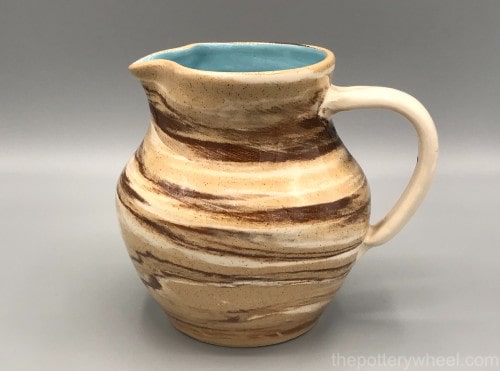
Marbling is a fantastic way of decorating pottery. There are a number of different ways of achieving a marbled effect on your pots. And depending on the approach you use you can marble pottery at different stages in its production. Let’s have a look at 3 approaches to marbling… a) Agate Ware - one way to marble your pots is to create a marble effect in the clay itself. That is, you are using a combination of different colored clays to create the marbling.
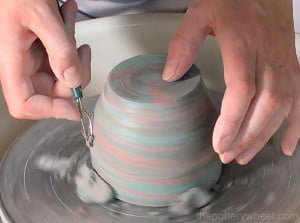
You can do this on the potter ’s wheel or when you are hand building. Whether you hand build or wheel throw you will need to get your hands on some colored clay. It is sometimes possible to mix different clay bodies with different colors together and fire them successfully. But sometimes they are not compatible and you can have problems when you are drying or firing them.It is suggested that one of the best way to combine different colored clay is to color quantities of the same clay body with different ceramic stains. Making colored clay is quite a simple (if messy) process. If you want to try coloring clay with ceramic stains. step-by-step guide found on the website thePotteryWheel.com about coloring clayHow to Make Agate Ware takes two balls of clay, colored with at least two different ceramic stains. Slice the balls of clay into sections and then sandwich the slices together alternating the colors. You will end up with a stack of clay made up of different colors. Pack the stack together to make a single ball of clay, and then wedge that ball of clay a few times. The wedging ensures that the slabs of clay are bonded together and will begin the marbling process.You can then throw this multicolored ball of clay in the same way that you would throw any ball of clay. The difference is, that when you throw the clay, the different colors will be dragged around the pot. After you have thrown the pot, you can scrape away the slip on the outside with a metal rib. This will reveal a lovely marbled clay effect. And trimming your pot when it’s leather hard will further enhance the effect.
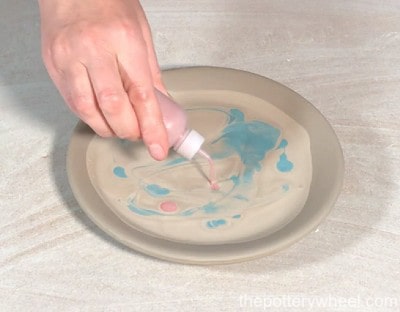
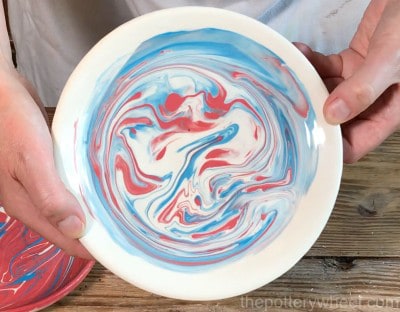
b) Marbling with Slip. You can also marble pottery when it is leather hard. The best way of decorating pottery in this way is to use colored slip. You can either buy colored decorating slip, or as mentioned above, you can make your own colored slip very easily.Fill a couple of slip trailing bulbs with at least two different colors of slip. You can also use plastic bottles with nozzles on them. The thePotteryWheel.com states that this technique works best on larger flatter pieces of pottery like plates, platters, and tiles. Sometimes before the marbling procedure starts maybe painting the plate with a block coat of coloring slip. But this isn’t essential. Once the background color is added, you could drizzle colored slip over the plate using the slip trailing bulb or dispenser. After adding the first color on the background you could drizzle another color over it and another. After a good amount of slip has been drizzled on, pick up the plate and tilt it around so that the slip runs and moves about the plate. This will create a marbling effect. Once you are happy with the marbling, let the plate dry slowly before you fire it.
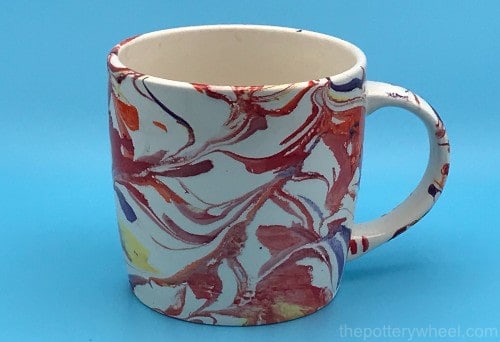
c) Marbling with Underglaze The third way of decorating pottery by marbling is to use underglaze on bisque ware. Perhaps the easiest way to do this is to spread a layer of shaving cream over a large tray. Then drizzle a combination of underglaze colors over the shaving cream. Make swirly patterns in the underglaze by dragging a pencil nib or modeling tool over the underglaze.
Then carefully roll your bisque ware over the surface of the shaving cream. The underglaze will transfer onto the surface of the bisque. Once the underglaze and shaving foam has been applied, let the mixture settle on the surface for a minute or two. Then put the bisque underneath a running tap and allow the water to wash away the excess mixture. What will be left behind is a marbling effect made by the underglaze colors. Once dry this can then be coated with clear glaze and glaze fired. Reference - thepotterywheel.com -
|
||||

About Me | Contact Me | Site Map
Property of Mr. D - 2023