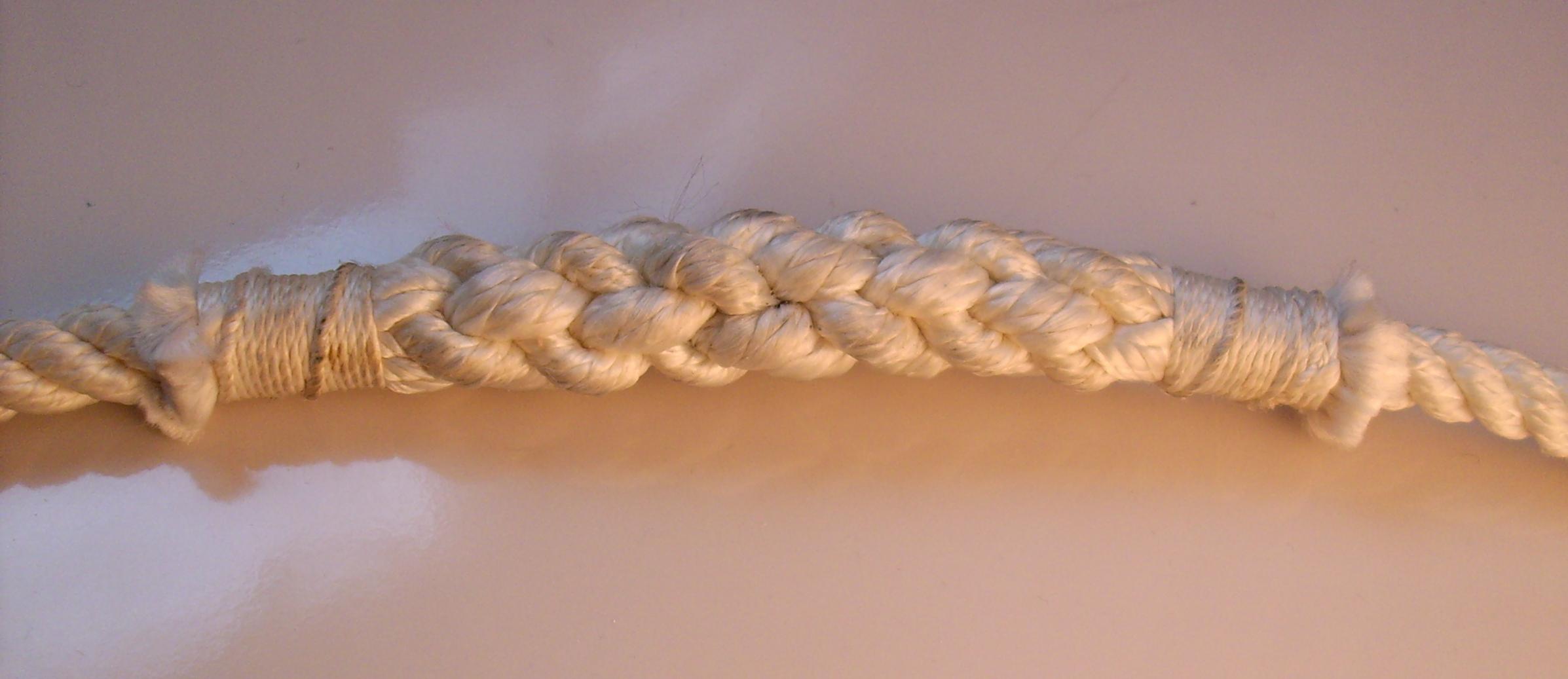
The following information is taken from the AY Honor for Knot Typing in the Seventh Day Adventist Pathfinder guidelines for this honor. The information is what they suggest to follow while learning the knots. I Mr. D will be adding additional helps to the guidelines that need to be done to meet the requirements of this honor.
Splice
A splice (short splice or long splice) is used to join the ends of two ropes and results in the spliced part being about twice as thick as the non spliced part. The short splice retains more of the rope strength than any knots that join rope ends. It is tied using the same techniques as the eye splice (see below).
( quoted from the AY Reference Document for Knot Tying in Pathfinders )
Splicing Animated
Splice Guide - ( New England Knot Guide )
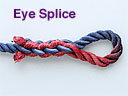
Eye splice
Use: The eye splice is the best method of creating a permanent loop in the end of multi stranded rope by means of rope splicing. The ends of the rope are tucked (plaited) back into the standing end to form the loop. Originally this splice was described with each end being tucked only about three times. When the splice was made in tarred hemp or cotton this was reasonably safe. With modern synthetic ropes, five complete tucks is a minimum and additional tucks are recommended for critical loads.
( quoted from the AY Reference Document for Knot Tying in Pathfinders )
How to tie:
The ends of the rope are first wrapped in tape or heated with a flame to prevent each end from fraying completely. The rope is unlayed for a distance equal to three times the diameter for each "tuck", e.g., for five tucks in half inch rope, undo about 7.5 inches. Wrap the rope at that point to prevent it unwinding further. Form the loop and plait the three ends back against the twist of the rope. Practice is required to keep each end retaining its twist and lie neatly.
| |
|
 |
Eye Splice Animated
Back splice
A back splice (also called an end splice) is a splice where the strands of the end of the rope are spliced directly back into the end without forming a loop. It is used to finish off the end of the rope to keep it from fraying. The end of the rope with the splice is about twice the thickness of the rest of the rope. Begin by unraveling the strands, and tie a crown knot. Then begin splicing the rope onto itself as with the short splice.
( quoted from the AY Reference Document for Knot Tying in Pathfinders )
Back Splice Animated
Finish one of the following knots : double crown, whiping, or a Matthew Walker's knot.
Double crown
Use: A double crown knot is a decorative knot tied on the end of a laid rope to prevent it from unraveling.
How to tie:
1. Tie a crown knot in the end of the rope.
2. Pull the three strands upwards, away from the standing part, and tie another crown knot. Common whipping
Whipping
Use: The common whipping is the simplest type of whipping knot, a series of knots intended to stop a rope from unraveling. As it can slip off of the rope easily, the common whipping should not be used for rope ends that will be handled. This whipping knot is also called 'wolf' whipping Adventist Youth Honors – Knots – Advanced Page 8 in some parts of the world.
The benefit of a common whipping is that no tools are necessary and the rope does not need to be unlayered. The problem is that it will slide off the end of the rope with little provocation. Other whippings avoid this by interweaving the whipping with the strands of the rope and creating friction with the strands to avoid slipping.
Normally a natural fiber rope is whipped with twine. The size of the rope dictates the size of the twine. Any twine can be used, but tarred two strand hemp (marline) is preferred. Artificial-fiber ropes should have their ends fused by heat rather than whipped to prevent unraveling.
Common Whipping | How to tie a Common Whipping Knot animated and illustrated.
( quoted from the AY Reference Document for Knot Tying in Pathfinders )
How to tie:
The rope should be whipped a short distance (One and a half times the diameter) from its end.
Lay the head of the twine along the rope, make a bight back along the rope
Begin wrapping the twine around the rope and bight of twine securely.
Wrap until the whipping is one and a half times wider than the rope is thick.
Slip the working end of the twine through the bight.
Cut the twine flush with the edges of the whipping and the rope end not less than half its width from the whipping to give the rope end a finished look
Matthew Walker's
Use: A Matthew Walker knot is a decorative knot that is used to keep the end of a rope from fraying. It is tied by unraveling the strands of a twisted rope, knotting the strands together, then laying up the strands together again. It may also be tied using several separate cords, in which case it keeps the cords together in a bundle.
( quoted from the AY Reference Document for Knot Tying in Pathfinders )
How to tie:
A Matthew Walker knot is tied in a circular bundle of any number of strands. To tie the knot, the tier takes each strand and forms a loop around the rest of the bundle, then passes the end through the newly-formed loop to form an overhand knot. He then moves to the next strand over, moving around the bundle in the direction he passes the loops. Tying the first strand around the bundle is straightforward, but each subsequent end must be passed through the previously-formed loops in order to contain all of the other strands in its loop. When tightening, it may help to roll the knot along the bundle, especially when using only two strands. The final effect is a spiral knot vaguely resembling a section of a barber's pole.
Please listen to the Video for the needed information for the steps to follow.